
A 5,000-Year-Old Underground World Hidden in the Polish Landscape
At first glance, Krzemionki looks like a quiet archaeological reserve surrounded by woodland near Ostrowiec Świętokrzyski. There is little to suggest that beneath this peaceful landscape lies one of the most remarkable prehistoric mining complexes in Europe.
More than 4,000 prehistoric mines were once excavated here, forming an extraordinary industrial landscape created thousands of years before the pyramids of Egypt. Today, the Krzemionki Archaeological Museum and Reserve gives visitors the rare opportunity to walk through authentic prehistoric underground workings and discover how people extracted valuable striped flint using nothing more than stone, antler, wood, and enormous amounts of human effort.
It is not the kind of museum where history stays behind glass. At Krzemionki, you actually descend into it.
A Mine Older Than Most Ancient Civilizations
The story of Krzemionki began around 3900–1600 BC, when prehistoric communities came here to extract striped flint, a distinctive material used mainly to produce polished stone axes and other tools.
The mining field covers approximately 78.5 hectares and stretches for around 4.5 kilometres. Archaeologists estimate that roughly 4,000 prehistoric shafts and workings are preserved across the area.
What makes the site particularly remarkable is its state of preservation. The landscape still contains ancient mine shafts, spoil heaps and depressions marking places where prehistoric miners worked. Together, they form a rare archaeological landscape that allows visitors to understand the scale of an industry that existed thousands of years ago.
How Did Prehistoric Miners Work Underground?
Perhaps the most fascinating question is how people without metal tools or machinery managed to create such an extensive mining system.
The answer lies in a combination of geological knowledge, practical experience and extraordinary physical effort.
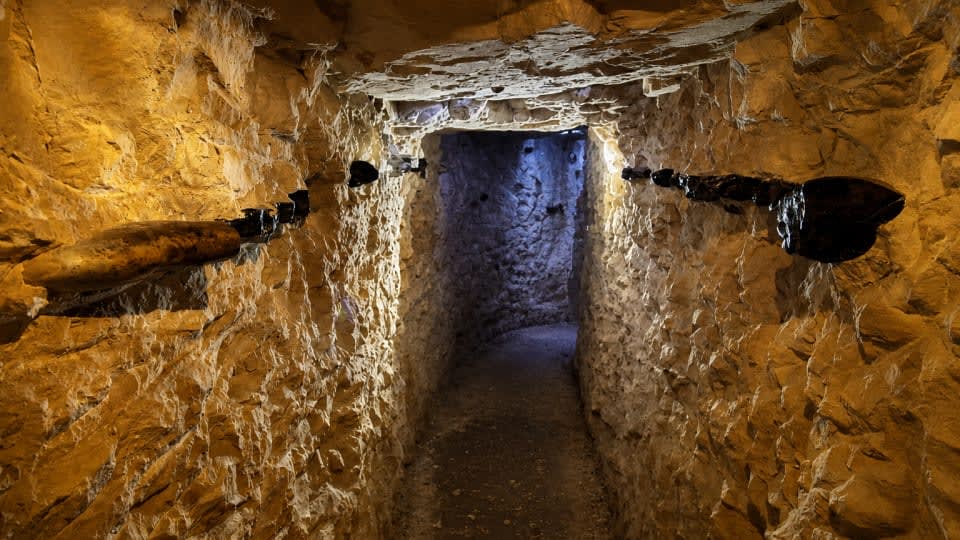
Archaeologists have identified several types of prehistoric mines at Krzemionki. The simplest were shallow pits, while the most sophisticated chamber mines reached depths of around 9 metres and could contain underground working areas covering several hundred square metres. Pillars of untouched limestone were deliberately left behind to support the ceiling.
The working conditions were extremely difficult. Some underground passages were only 55–120 centimetres high, meaning that miners had to work on their knees or even lying down. Temperatures remained around 5–9°C, while humidity was very high.
Their tools were remarkably simple: stone and flint axes, antler implements, wooden tools, pounders and mallets. Yet with these basic instruments, prehistoric communities created a highly organized mining system that operated for generations.
The Flint That Traveled Across Europe
Striped flint was more than just a local raw material.
During the height of its use, particularly in the first half of the 3rd millennium BC, tools made from Krzemionki flint traveled remarkable distances. Archaeological finds show that products from the mines reached locations as far as 660 kilometres away.
This reveals something important about prehistoric society. Long before roads, cities and written records, communities were already connected through extensive networks of exchange.
A piece of stone extracted in what is now central Poland could eventually become part of the daily life of someone living hundreds of kilometres away.
A Discovery Made Only in 1922
It is remarkable that such a huge prehistoric complex remained hidden for so long.
The mines were discovered in 1922 by geologist Jan Samsonowicz. His discovery marked the beginning of systematic archaeological research at Krzemionki and eventually led to the creation of the protected archaeological reserve.
Over the decades, archaeologists gradually uncovered the scale of the prehistoric mining field, while conservators developed ways to protect the exceptionally fragile underground remains.
The first section of the underground tourist route opened in 1985, followed by further sections and archaeological work. Between 2001 and 2004, separate sections were connected into the route visitors can explore today.
The Most Unusual Part of the Visit Is Underground
The highlight of a visit to Krzemionki is undoubtedly the underground tourist route.
The current underground section is approximately 465 metres long and reaches a depth of around 11.5 metres. It passes through exceptionally well-preserved prehistoric mining workings and also reveals the geological structure of the flint-bearing limestone.
Descending below the forest completely changes the atmosphere.
The light becomes subdued, the temperature drops, and the narrow underground spaces make it much easier to imagine what prehistoric miners experienced. There are no dramatic reconstructions needed—the surviving shafts, chambers and rock surfaces provide the story themselves.
According to the museum, Krzemionki's underground tourist route is unique in the world as a prehistoric flint-mining monument regularly accessible to visitors.
The Story Continues Above Ground
The archaeological reserve is not limited to what lies beneath the surface.
Visitors can also explore the reconstructed Neolithic settlement, which helps explain the world of the people who mined and processed the flint. The museum's educational programs and archaeological workshops use the reconstruction to demonstrate prehistoric technologies, crafts and everyday life.
The surrounding reserve also has natural value. Forests, grasslands and areas of limestone-loving vegetation create an interesting landscape where archaeological remains coexist with protected plant communities. The nature reserve covers almost 379 hectares.
This combination makes Krzemionki particularly rewarding: the visit connects archaeology, geology, nature and the history of technology in one place.
A Place That Changes the Way You See Prehistory
There is something surprisingly modern about Krzemionki.
The prehistoric miners had no engines, electricity or metal machinery, yet they understood the landscape, identified valuable geological deposits, organized underground work and transported their products across vast distances.
Standing inside one of the ancient chambers, it becomes clear that prehistoric societies were far more technologically capable and economically connected than the word "prehistoric" might suggest.
Krzemionki turns an abstract period of history into something tangible. You can see the marks left by human activity, walk through the spaces where people worked, and follow the same underground layers that they encountered thousands of years ago.
Why Visit the Krzemionki Archaeological Museum and Reserve?
If you are looking for unusual places to visit in Poland, Krzemionki deserves a place high on the list. It offers something that few archaeological sites can: the possibility of entering an authentic prehistoric mining landscape rather than simply looking at objects recovered from it.
The visit combines an archaeological museum, a reconstructed settlement, a forest reserve and an underground journey through Neolithic mines. The complete guided experience takes around 1.5–2 hours, and visitors should remember that temperatures underground remain around 7–9°C, even in summer.
For anyone interested in prehistoric Poland, archaeology, ancient mining, geology or unusual attractions near Ostrowiec Świętokrzyski, Krzemionki offers a genuinely memorable experience.
The most striking thing is perhaps the simplest: when you walk through these underground passages, you are not walking through a modern reconstruction. You are following a landscape shaped by people who lived thousands of years ago.