
European Solidarity Centre in Gdańsk – History, Solidarity and the Road to Freedom
The European Solidarity Centre (ECS) in Gdańsk is much more than a museum. Located on the grounds of the former Gdańsk Shipyard, it tells the story of one of the most important peaceful social movements in modern European history and the events that helped transform Poland and Central and Eastern Europe.
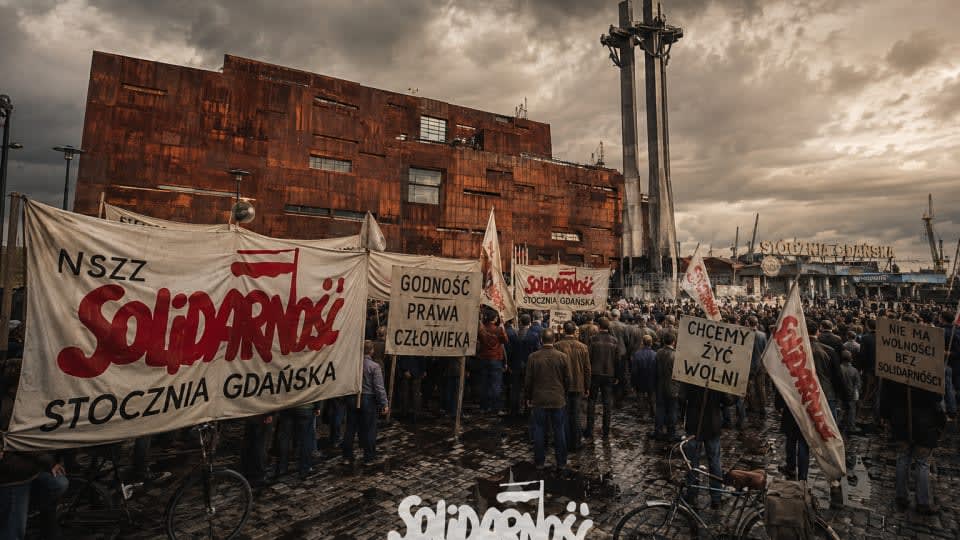
This is where the Solidarity movement was born in August 1980, when striking shipyard workers presented their demands to the communist authorities. Today, the centre preserves the memory of those events while connecting them with broader questions about freedom, democracy, human rights and civic responsibility.
A Place Where History Happened
The location of the European Solidarity Centre is an essential part of the experience.
The building stands beside Solidarity Square, close to the historic Shipyard Gate No. 2 and the Monument to the Fallen Shipyard Workers of 1970. These are not simply museum reconstructions or symbolic decorations – they are genuine places connected with the events presented inside the centre.
The Gdańsk Shipyard became the stage for the August 1980 strike, which led to the creation of the independent trade union Solidarność. The movement eventually grew into a mass social force and became one of the most important elements in Poland's peaceful transition away from communist rule.
The Architecture of the European Solidarity Centre
The ECS building itself is one of the most distinctive examples of contemporary architecture in Gdańsk.
Its designers deliberately created a structure that refers to the industrial character of the former shipyard. The exterior is covered with weathering COR-TEN steel, whose rusty colour evokes the hulls of ships once built at the shipyard.
The result is a building that feels both modern and deeply connected to its surroundings.
Inside, the industrial atmosphere continues, but the spaces are transformed into galleries, exhibition halls, a library, archive, educational facilities and areas for cultural events.
The Permanent Exhibition
The heart of the European Solidarity Centre is its permanent exhibition, spread across almost 3,000 square metres and divided into seven exhibition halls.
More than 1,800 exhibits tell the story through photographs, documents, personal belongings, manuscripts, films, multimedia installations and objects connected with the history of the Solidarity movement. The exhibition was created using material gathered from museums, archives and private collections across Central and Eastern Europe.
Instead of presenting history as a simple sequence of dates, the exhibition focuses strongly on people and their experiences.
That makes the visit particularly engaging. Political events are presented alongside everyday life, personal stories and the choices made by people living under an authoritarian system.
The 21 Demands of the Striking Workers
Among the most important objects in the museum are the original 21 Demands of the striking workers.
On 17 August 1980, workers occupying the Gdańsk Lenin Shipyard wrote down their key demands and displayed them on Gate No. 2. The strike eventually resulted in the creation of Solidarność.
The boards are now included in UNESCO's Memory of the World Register, which recognises documents of outstanding significance to the history of humanity.
Seeing the original boards makes the history of August 1980 feel remarkably tangible. What might seem like a distant political event suddenly becomes something physical – handwritten demands created by people who did not know how their protest would change the future.
From the 1970 Protests to Solidarity
The story at ECS does not begin in 1980.
The exhibition also explores the violent protests on the Polish Baltic coast in December 1970, when 45 people were killed by police and military forces. Those events became an important part of the social and political background that eventually led to the August strikes a decade later.
The exhibition then follows the development of Solidarity, its enormous growth and the hopes that emerged during the early 1980s.
For a short period, Poland experienced an extraordinary mobilisation of society on a scale that was almost unimaginable within the communist system.
Martial Law and the Underground Opposition
The story also takes a darker turn.
In December 1981, the communist authorities introduced martial law, attempting to suppress the Solidarity movement. Activists were arrested, the organisation was banned and opposition activity was forced underground.
The ECS exhibition presents this period through documents, photographs and personal objects, showing not only the political repression but also how ordinary people responded to it.
This part of the exhibition helps explain why the later collapse of communism cannot be understood simply as a political decision made by a few leaders. It was the result of years of social resistance, organisation and pressure.
From Gdańsk to a Changing Europe
The significance of Solidarity extends far beyond Poland.
The movement became an important symbol of peaceful resistance against communist rule and influenced the political transformation of Central and Eastern Europe. The ECS permanent exhibition therefore follows the story beyond Poland and places the events in Gdańsk within the wider European context.
The result is a fascinating perspective on the late twentieth century: the history of one shipyard city becomes part of a much larger story about the end of the Cold War and the transformation of Europe.
The Shipyard: Man, Industry, City
Another important part of the centre is the exhibition “SHIPYARD. Man. Industry. City.”
Rather than focusing exclusively on ships and technology, the exhibition explores the history of Gdańsk's shipbuilding industry through the people who worked there and the city that grew around it. It places the shipyard within more than 150 years of Gdańsk's industrial, social and cultural history.
This makes it a useful complement to the main exhibition.
After learning about the political events that took place at the shipyard, visitors can better understand what the shipyard actually meant to generations of Gdańsk residents.
More Than a Museum
One of the things that distinguishes the European Solidarity Centre from a traditional museum is the range of activities taking place beyond its exhibitions.
ECS includes an educational centre, research centre, archive, library and media library. It also hosts debates, conferences, cultural events, temporary exhibitions, film screenings and educational programmes.
The archive, operating since 2008, collects documents relating to social resistance, Solidarity and the democratic opposition in Poland and abroad, making the institution important not only for tourists but also for historians and researchers.
A Museum About Freedom
The most interesting aspect of the European Solidarity Centre is that its story does not feel completely finished.
The events of 1980 and 1989 belong to history, but the questions they raise remain relevant: What does freedom mean? How does an ordinary person respond to an unjust system? Can peaceful protest change political reality? And how can democratic societies preserve the values that earlier generations fought to achieve?
This is why ECS describes itself as more than a museum. Its mission is not simply to preserve the past, but to encourage people to think about democracy, civic participation and solidarity today.
European Solidarity Centre – Practical Information
The European Solidarity Centre is located at Solidarity Square 1 in Gdańsk, directly within the historic former shipyard area. The permanent exhibition is the main attraction, but it is worth checking the current programme for temporary exhibitions and events before visiting.
Is the European Solidarity Centre Worth Visiting?
Absolutely – especially if you are interested in Gdańsk, Polish history, Solidarity, the Cold War, European history, communism or modern architecture.
Even if you arrive without much previous knowledge of the Solidarity movement, the exhibition provides enough context to understand why the events of August 1980 were so important.
And perhaps the most powerful part of the experience is stepping outside after the exhibition and seeing the actual shipyard gates, the workers' monument and the industrial landscape that formed the backdrop to the story.
At that moment, the history presented inside the museum no longer feels distant.
It happened here.